


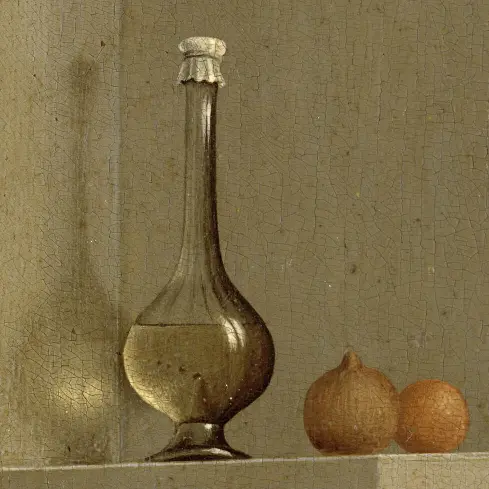
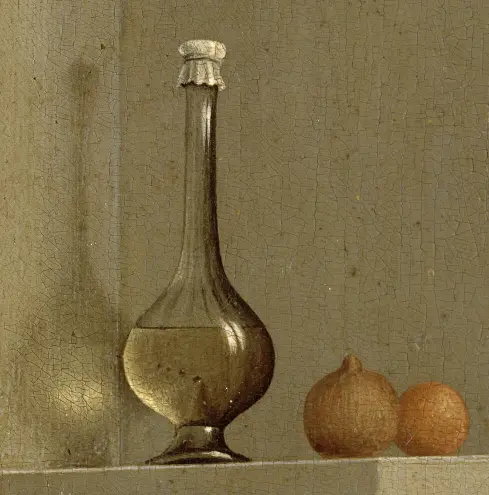
With the start of the new year comes a new type of lecture, devoted to a theme that will be considered over four sessions/seasons, over a long period of time, first in the Middle Ages, then beyond that period. This year's theme is still life.
According to a certain 'official' history, the still life - that is, the representation of a more or less organised collection of inanimate objects as the sole subject of a work - is an artistic genre that did not exist in the West in the Middle Ages: the first still life worthy of the name did not appear until 1504, in the first decade of the 16th century...
Of course, this pattern needs to be qualified, because the art of the still life, which was very active in Greco-Roman antiquity, never really disappeared after that. Even if it did not constitute an independent genre, it was indeed present, albeit often very discreetly, in the second half of the Middle Ages, and even earlier.
A closer look at European pictorial production shows that from the fifteenth century onwards, still lifes were produced for their own sake. Italy and the northern schools played a leading role in this emergence. Here's a look back at a phenomenon that ushered in a new way of looking at the world.
According to a certain 'official' history, the still life - that is, the representation of a more or less organised collection of inanimate objects as the sole subject of a work - is an artistic genre that did not exist in the West in the Middle Ages: the first still life worthy of the name did not appear until 1504, in the first decade of the 16th century...
Of course, this pattern needs to be qualified, because the art of the still life, which was very active in Greco-Roman antiquity, never really disappeared after that. Even if it did not constitute an independent genre, it was indeed present, albeit often very discreetly, in the second half of the Middle Ages, and even earlier.
A closer look at European pictorial production shows that from the fifteenth century onwards, still lifes were produced for their own sake. Italy and the northern schools played a leading role in this emergence. Here's a look back at a phenomenon that ushered in a new way of looking at the world.
Opening times
Opening times
On 5 January 2026
- 14:30
- 17:00
On 6 January 2026
- 18:30
On 8 January 2026
- 20:00